A faster length can make a technical change look successful before anyone has identified what changed. Perhaps the swimmer increased stroke rate, reduced breathing frequency or pushed harder from the wall. Video helps separate those possibilities, provided it is collected to answer a question rather than to decorate a result. Begin with one observable claim: for example, whether head movement during breathing coincides with a repeatable change in body alignment.
Make the comparison fair
Record the swimming speed, intended effort, stroke, pool length and position within the repetition. A fresh technical drill and the final length of a demanding set are different conditions. Compare like with like before explaining differences as improvements. Keep the camera location, lens setting and viewing direction as consistent as practical. Include the lane markings or another fixed reference so the footage retains a spatial context.
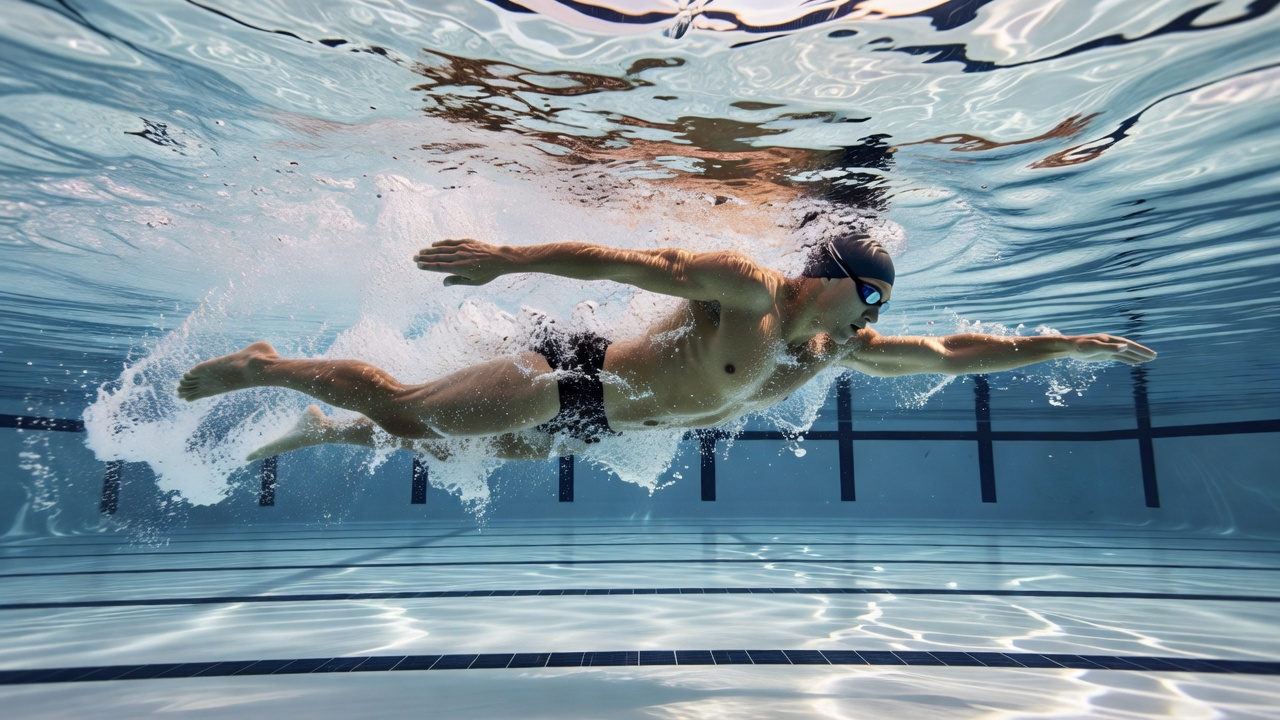
An underwater side view can reveal the sequence of the arm action, but movement towards or away from the lens distorts apparent distances. Refraction through a housing or viewing window also affects geometry. A frontal view answers different questions about lateral movement and symmetry. Neither view alone establishes three-dimensional joint motion. If measuring angles or distances, describe the calibration procedure and restrict claims to the plane that the setup can reasonably resolve.
Define a cycle before counting it
For alternating strokes, a full cycle commonly runs from one hand entry to the next entry of that same hand. Analysts sometimes report individual arm strokes instead. Both conventions can be useful, but an unlabeled number invites a twofold misunderstanding. State the convention, the number of cycles observed and whether the sample includes a breath. For breaststroke and butterfly, define a repeatable event appropriate to the stroke.
- Stroke rate
- Cycles per unit time, with the counting convention stated explicitly.
- Distance per cycle
- Distance travelled divided by complete cycles in a defined segment; wall contributions must be excluded or identified.
- Temporal resolution
- The interval between recorded frames. At 50 frames per second, adjacent frames are 0.02 seconds apart; event selection adds further uncertainty.
Average several cycles instead of choosing the prettiest example. Show the spread as well as the average when the pattern varies. Frame rate alone does not guarantee useful footage: motion blur, poor illumination, compression and an obstructed hand entry can all make event identification unreliable. Preserve original files when possible, and avoid measuring timing from a slow-motion export unless its playback timing is understood.
Separate an observation from its explanation
Observation
The head returns later relative to hand entry in three sampled breathing cycles at the target pace.
Interpretation
This may affect alignment or coordination. The footage alone does not establish extra drag or identify the cause.
This distinction protects both coach and swimmer. A movement can be unusual without being the main performance constraint. Limb proportions, mobility, preferred coordination and race demands influence the pattern. Apparent left–right differences also require caution: a breathing-side view can make asymmetry more visible than a non-breathing view, even when the underlying action is stable.
The coordination work of Didier Chollet, Sébastien Chalies and Jean-Claude Chatard provides a useful example of defining timing relationships rather than relying on a global impression. Their index of coordination describes relationships between propulsive arm phases in front crawl. It is not a universal score for good technique, nor a prescription that every swimmer should adopt the same coordination at every speed.
Bring one question back to practice
Choose a cue that the swimmer can understand, then repeat the recording under comparable conditions. Ask whether the intended movement changed, whether pace or effort changed, and whether the swimmer could reproduce it without continuous prompting. If the movement changes but performance does not, retain that finding rather than inventing a benefit. A short trial is evidence about that trial, not proof of long-term adaptation.
Automated pose estimation can speed up annotation, but underwater occlusion, bubbles and unfamiliar camera angles can produce confident-looking errors. Review landmarks against the original frames and document manual corrections. The useful endpoint is not a perfect skeleton overlay. It is a dependable observation that helps a coach choose the next test while acknowledging what remains unresolved.
Further reading: Chollet, Chalies and Chatard on front-crawl coordination; our source register and editorial method.