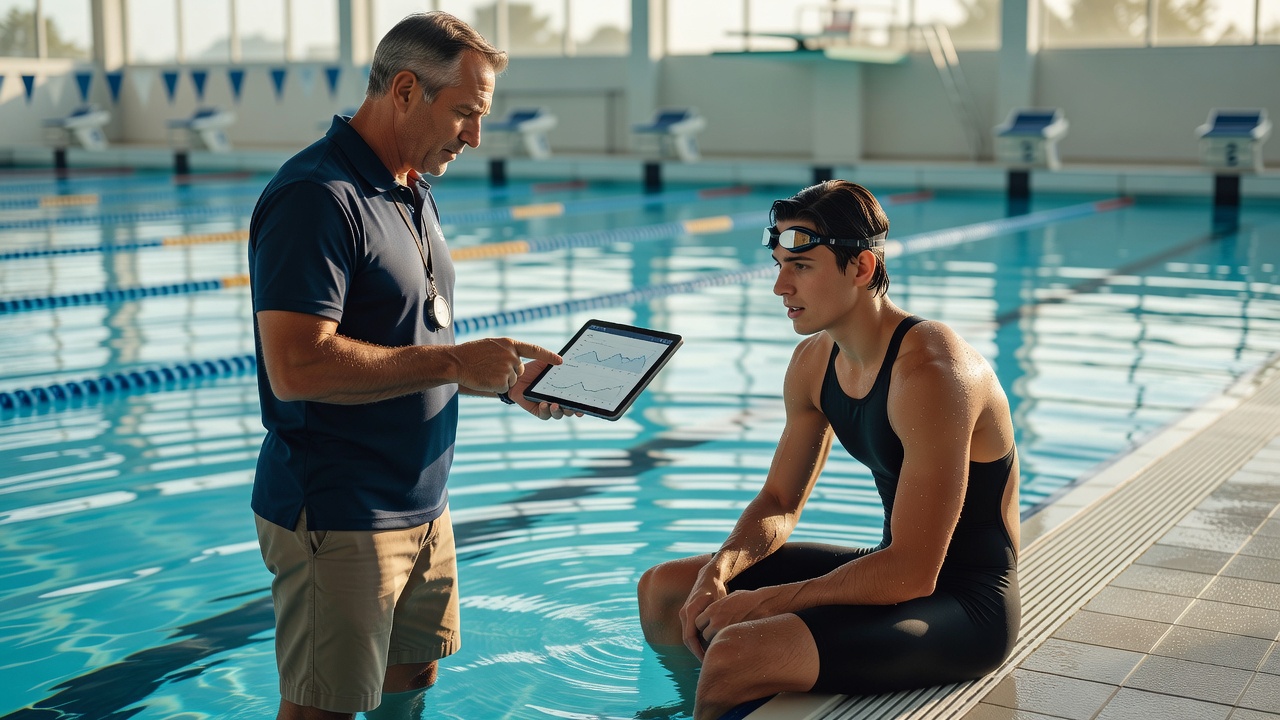
A report can be accurate and still be unusable. If the coach cannot see the question, the swimmer cannot recognise the action, or the uncertainty is buried beneath a bold headline, the measurement has not completed its job. Start by agreeing what decision the review should inform. A narrow question about turn departure usually produces a more useful report than an open request to analyse everything.
Write the question before the dashboard
State the performance context in a short opening paragraph: event, pool length, intended pace, training phase and reason for the review. Record whether the session was a controlled test or ordinary practice. The distinction affects what can be inferred. An observation from routine training may be highly valuable, but it does not acquire experimental control because it appears in a professionally formatted chart.
Choose a primary outcome and a small number of supporting observations. For a turn review, the outcome might be time through a defined segment; supporting observations might include approach speed, departure direction and breakout timing. Specify the protocol in advance when possible. This reduces the temptation to select whichever metric happens to improve after the session.
Keep a measurement trail
Save original files, session notes and the definitions used to create each value. Record the device, software version where relevant, camera view, sensor placement and processing settings. Name files consistently without exposing unnecessary personal information. A pseudonymous athlete identifier can make working folders easier to handle, although a reversible identifier is still personal data when it can be linked back to a person.
Flag missing data and unusable trials openly. Do not replace a lost measurement with an estimate unless the method is clearly identified and justified. When manual annotation is involved, re-score a sample without looking at the first result, or have a second analyst score it. Disagreement helps reveal whether the event definition or camera view needs improvement.
- Reliability
- How consistently a method measures under specified repeat conditions.
- Validity
- Whether the measure supports the interpretation and use being proposed.
- Meaningful change
- A change important enough for the coaching decision, considered alongside measurement error and normal performance variation.
Give uncertainty a visible place
Measurement error and biological variation are not the same thing, but both affect comparisons. A swimmer may reproduce a movement differently even when the device is stable. Describe the repeatability information available for the actual protocol; a manufacturer's laboratory specification cannot automatically represent a wet poolside setup with moving cameras and partly obscured events.
The agreement methods associated with J. Martin Bland and Douglas Altman are useful when comparing two measurement methods, because a high correlation does not prove close agreement. William G. Hopkins and colleagues have also written extensively about reliability in sports measurement. These are methodological tools, not a reason to add statistical decoration to a small sample. Explain the uncertainty in words before relying on a technical summary.
What changed
The defined segment was faster across the repeated trials collected under the revised cue.
What remains open
The session does not establish whether the effect persists when tired, transfers to competition or results from the cue alone.
Finish with a limited next step
A useful conclusion links evidence to action without pretending the inference is certain. State the observation, offer a qualified explanation, choose one practical cue or task, and define the follow-up. Include what would count against the explanation. If the cue changes the intended movement but not the outcome, that is a useful result and may justify looking elsewhere.
Let the swimmer's experience inform the interpretation. A faster trial achieved through an unsustainable effort may not be a suitable race solution. Ask about perceived effort, breathing comfort and whether the task felt reproducible. These reports are contextual evidence rather than objective mechanical measurements, but excluding them can make the final decision less informed.
Keep the main report short enough to discuss at poolside, with detailed methods and selected clips available separately. Use captions that distinguish observed events from inferred mechanisms. Avoid colour-only coding, unexplained composite scores and precision beyond the measurement. Access should be limited to the people who need it, particularly when footage includes children or other swimmers.
The final page should name a review point, not promise improvement. Repeat the agreed protocol when appropriate, compare like with like and keep the earlier record intact. Good reporting creates an accountable learning cycle: a clear question, a defensible observation, a proportionate action and a chance to discover that the first explanation was incomplete.
Further reading: Bland–Altman agreement methods; reliability in sports measurement.