A swimmer can improve a race split without changing surface-stroke speed. A better approach to the wall, a cleaner rotation or a more effective transition may explain the difference. Conversely, an impressive underwater section can conceal a slow approach or a poor breakout. Race analysis becomes informative when each phase has a defined boundary and the transitions between phases remain visible.
Choose boundaries before timing
A start measure might run from the starting signal to the head crossing a specified distance. A turn measure might begin a fixed distance before the wall and end a fixed distance after it. These are analysis conventions, not interchangeable definitions. State the distance, body landmark and timing method for every comparison. Without that information, two reports can use the same label for substantially different tasks.
Lane markings help, but they do not automatically provide a calibrated measurement plane. An oblique camera introduces parallax: the swimmer may appear to cross a reference before or after the actual event. Prefer a view perpendicular to the timing plane when practical, and use the same landmark across trials. When combining cameras, synchronise their clocks or identify a shared visible event, then describe the remaining timing uncertainty.
Read the whole start
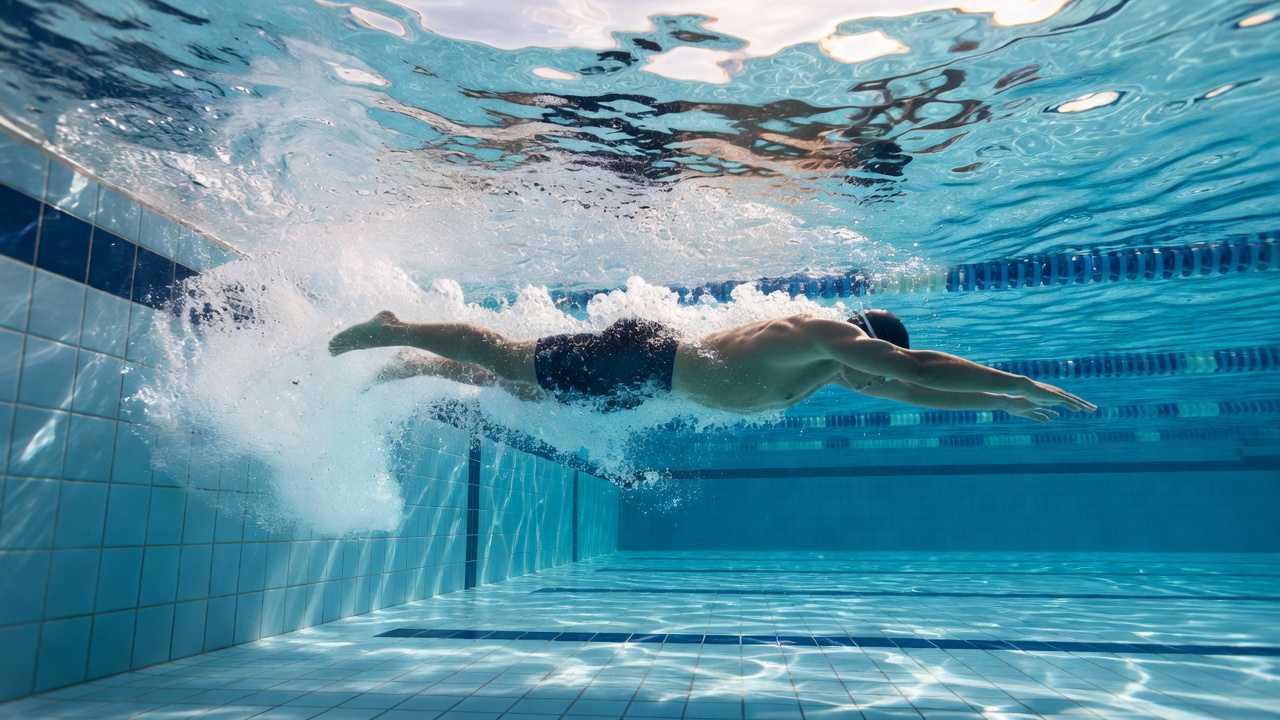
A short block time can be attractive, but leaving earlier is not the only objective. Flight, entry, underwater travel and the first surface cycles determine what follows. Instrumented blocks may distinguish aspects of reaction and force application; ordinary video cannot reproduce every one of those measurements. Record the start type, block setup and instructions so that a technical change is not confused with a different task.
Use current World Aquatics regulations for the event being reviewed. Freestyle, backstroke and butterfly have underwater distance restrictions associated with the 15-metre mark after starts and turns; breaststroke has different pullout provisions. The precise rules and exceptions matter. This article is an analysis guide, not a substitute for the current competition regulations or an official's interpretation.
Measure the wall as a sequence
Break the turn into approach, rotation or touch sequence, wall contact, push-off and departure. A swimmer who reaches farther before turning may reduce one interval while losing approach speed. Another may increase wall-contact duration but leave with a more useful direction and body line. Local timings are explanatory clues; the total defined turn segment tests whether the combined action actually improved.
| Measure | Useful for | Cannot establish alone |
|---|---|---|
| Signal to a set distance | Overall start outcome | Which start component caused a change |
| Defined turn segment | Combined approach and departure | Wall force or technical mechanism |
| Breakout distance | Locating the transition | Whether a longer underwater phase is faster |
| Final segment time | Finish execution at race pace | Whether the final touch is legal |
Wearable inertial sensors can help identify turns and segment repeated lengths, especially when long recordings are impractical. Their event-detection algorithms still need checking against a reference. A change in stroke, device placement or push-off style can affect detection. Report missing or uncertain events instead of silently converting them into exact-looking phase times.
Protect the transition
Longer underwater travel is not automatically better. The relevant question is whether speed is maintained and transferred into surface swimming within the rules and the swimmer's capabilities. Compare the entire start or turn segment, not just the distance travelled underwater. Watch the first surface cycle for a pause, an abrupt change in alignment or a poorly timed breath that may consume an earlier gain.
At race pace, fatigue can change the preferred solution. An approach that works on the first length may be unreliable late in the event. Include representative repetitions and recovery conditions, while avoiding unsafe breath-holding challenges. Underwater work requires appropriate supervision and must never be treated as a contest to suppress the urge to breathe.
Research by Julien Vantorre, Didier Chollet and Ludovic Seifert on starts, and by David P. Veiga and colleagues on race analysis, offers useful frameworks for examining these components. The practical conclusion remains modest: identify the phase where time changes, inspect the mechanism, and check that an apparent gain survives the next phase under comparable conditions.
Further reading: World Aquatics competition regulations; swimming-start biomechanics research.